
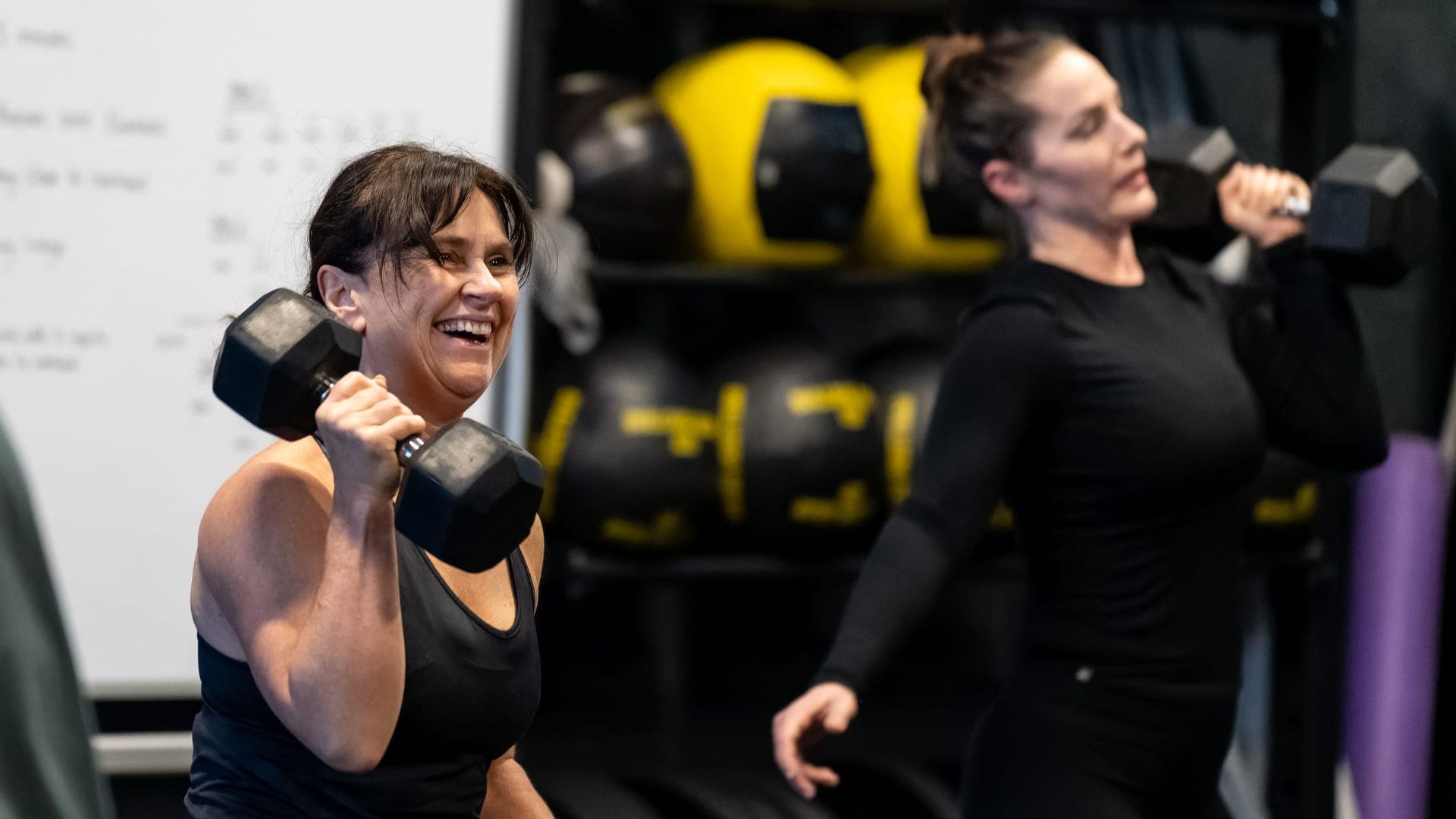
If you have run, cycled or swum for years and you’re starting to feel that it doesn’t hold age at bay the way it used to, you’re not imagining it. Strength training after 40 fills a gap that cardio leaves open. This article explains what that gap is, what strength work adds, and how to start well without giving up the cardio you enjoy.
Why you feel softer, stiffer or slower despite all that cardio
The pattern we see most is someone who has run, cycled or swum for years, is still fit on paper, but says they feel weaker than they used to. Getting up off the floor takes a hand. Carrying the shopping in, lifting a suitcase into the overhead locker or picking up a child feels harder than it should.
Aches are the other one. Ankles, knees and hips that complain more after a run or a ride than they used to, a lower back that’s often sore, and niggles that take longer to clear.
Some people feel softer around the middle even though the weekly mileage hasn’t changed. The same routine that used to hold their shape doesn’t any more.
And slower, but not in the way they expect. Their endurance is often fine. What has gone is the snap: sprinting for a train, jumping, reacting quickly.
The common thread is that they are doing everything they used to do and assume it should still be enough. Their effort hasn’t changed. What their body needs from them has.
What cardio still does well (and where it runs out)
Cardio is not the enemy, and this isn’t a post to knock it. It does a lot well: a stronger heart and lungs, better blood pressure, better mood and sleep, and it helps manage weight. Cardiorespiratory fitness is one of the strongest predictors of how long and how well people live, so anyone with a running, cycling or swimming habit should keep it.
Where it runs out is that it trains one or two qualities, mainly endurance and stamina. It does very little for strength, power, balance or bone. CrossFit describes fitness as ten general physical skills: endurance, stamina, strength, flexibility, power, speed, coordination, agility, balance and accuracy. Long steady cardio covers a couple of them well and leaves the rest to fade.
There’s a practical cost too. Running and most cardio are high-repetition work: thousands of steps or pedal strokes, each one asking your ankles, knees, hips and lower back to absorb a little load. When the muscles around those joints are strong (glutes, hamstrings, quads, calves, lower back), the body soaks that up, even over a marathon. When they aren’t, the same repetition wears on structures that can’t support it, and that’s where the aches, and often the injuries, come from.
The simple way to put it: your heart and lungs are in great shape, but your muscles and bones are on their own. Running more miles won’t fix a weak back or legs that struggle to get you up off the floor, in the same way lifting weights won’t make you better at a 10k.
In your 20s and 30s you get away with it because you have muscle in the bank. After 40 that buffer starts to shrink, so the gap shows. Strength training isn’t a cure-all and cardio isn’t wasted. The point is balance, not swapping one for the other.
What happens to muscle and strength after 40
From around your 30s you start to lose muscle gradually if you do nothing to keep it. The figure usually quoted from the research is roughly 3 to 8 per cent of muscle mass per decade after 30, speeding up after 60. The medical term is sarcopenia.
Strength drops faster than muscle size, and power (the ability to move quickly and forcefully) drops faster still. That’s why the first things people notice are getting up off the floor, climbing stairs, or catching themselves when they trip.
Bone density follows a similar path, and for women it drops more sharply around menopause. Less muscle also means a slower metabolism and worse blood sugar control, which is part of why people get softer around the middle on the same routine.
None of this is a cliff edge. It’s a slow slide, which is why it’s easy to ignore until it’s obvious.
The misconception we hear most is “It’s too late for me” or “I’m too old to start lifting.” The honest answer is that muscle responds to training at any age. There are studies of people in their 80s and 90s gaining meaningful strength in a few months of lifting. At 45 you are nowhere near too late. You are exactly when it matters.
The other one is “I’ll get bulky.” You won’t. Building muscle is slow at any age, and after 40 the goal is holding on to and rebuilding what you have.
What strength training after 40 actually adds
In everyday terms: getting up off the floor without using your hands. Carrying all the shopping in one trip. Lifting a suitcase or a child without thinking about your back. Going up stairs two at a time. Feeling steadier on your feet and catching yourself when you trip.
It builds and holds on to muscle, which cardio doesn’t, and it loads your bones, which helps keep them strong. Stronger muscles around the knees, hips and back usually make running, cycling and everyday life feel better, not worse. It also trains the qualities cardio leaves out: strength, power, balance and coordination.
The way we coach it is around real-life movements rather than machines: squatting (sitting down and standing up), hinging (picking things up off the floor), pressing overhead, pulling and carrying. We hold people to life standards, not competition standards. A full squat means you can still get up off a low chair or the floor at 80.
We tell new members we’re training them for the rest of their life, not for a competition: strong enough to do whatever life asks of them. And we start lighter than you’d think and build from there.
To keep it honest: strength training won’t turn back the clock or fix everything, and it won’t make you bulky. What it does is slow the slide, and for most people it makes everyday life feel noticeably easier within a few months.
How often should you strength train after 40?
The UK Chief Medical Officers’ guidelines say adults should do muscle-strengthening activity on at least two days a week, on top of their 150 minutes of moderate activity. Most people over 40 aren’t doing the strength part at all.
For a beginner in their 40s, we’d usually suggest two sessions a week to start, building to three once it feels routine. Two full-body sessions a week is enough to make real progress. Three is the sweet spot for most people.
Each session doesn’t need to be long. 45 minutes to an hour including a proper warm-up is plenty. Our classes run for an hour and everything is done for you: the warm-up is written, the cool-down is run, the sets and reps are set, and the coach shows you how to do each movement and what weight to use. You just walk through the door, which matters when work and family already take all your thinking. Full-body sessions beat body-part splits for this age group and time budget: squat, hinge, press, pull and carry, either every session or across the week.
Consistency matters far more than the perfect plan. Two sessions every week for a year beats five a week for a month and then stopping.
More isn’t better, either. Better is better. CrossFit’s founder, Greg Glassman, argued that intensity, not volume, is what drives results. Fifteen minutes of genuinely hard work, relative to where you are, gives your body far more reason to adapt than two hours of going through the motions, whether you’re 25 or 55.
If you’re still doing cardio several days a week, keep it. Start with two strength sessions and treat them as fixed appointments. Drop or shorten one easy cardio session rather than adding to an already full week, at least for the first month while your body adapts. Stack hard days together and keep easy days easy, so you aren’t doing a heavy leg session the day before a long run.
Recovery counts as part of the plan: sleep, enough protein, and at least one full rest day a week.
Keeping your running, cycling or swimming while you add strength
You don’t have to give anything up. Strength work usually makes running, cycling and swimming better. Stronger legs, hips and trunk mean better posture late in a run, more power on a climb, a stronger pull in the water, and for many people fewer niggles.
The worry that lifting will make you slower or heavier doesn’t hold up for someone training two or three times a week. You will not build enough muscle to slow you down. You’ll more likely find the hills feel easier. Some of our members have finished full Ironmans and run the London Marathon while training with us, using the strength work to stay strong while they put the miles in. You may need to trim your cardio slightly at first, while your body adapts to something new.
Some scheduling tips:
- Keep hard days hard and easy days easy. If you can, put strength on the same day as a harder cardio session (strength in the morning and the ride or run later, or the other way round with a few hours between) so your easy days stay genuinely easy.
- Don’t do a heavy leg session the day before a long run, ride or swim, or before a race. Two days’ gap is better.
- If both are on the same day and strength is the priority, lift first. If the cardio session is the priority that day, do it first.
- Expect your legs to feel heavier in the first two or three weeks. That passes as your body gets used to it.
- Around an event or race, ease off the strength work for the last week or so rather than stopping altogether.
A coach can fit the sessions around your existing week. Tell us what you’re training for and we’ll scale the day’s workout to suit.
What your first few weeks of strength training can look like
At CrossFit Tunbridge Wells every session is a coached class, run by one of our coaches. Classes last an hour, with times from 6am through to the evening on weekdays.
Your first class is free. Arrive 10 to 15 minutes early. The coach shows you round, asks why you’ve come and about any injuries or health background, then walks you through that day’s whole workout one to one, including how it will be scaled for you. By the time the class starts you already know exactly what you’re doing, so you’re never stood there confused while everyone else gets going.
A typical class has a warm-up that gets your joints moving, then a strength or skill piece, then a shorter conditioning workout, then a cool-down. The strength part uses the basic movements: squat, deadlift (picking something up from the floor), pressing overhead, pulling and carrying.
Loads in the first few weeks are light, often just a bar, a kettlebell or a box to squat to. We want the movement right before we add weight. You should finish feeling you could have done a bit more.
The coach watches every rep and corrects as you go, so you learn to move well from day one. Everyone does the same workout, scaled to them by changing the weight, the reps, the range of movement or the exercise itself. We’d always rather you lift a bit lighter and move well than chase a number. If you’re carrying a niggle or an old injury, tell the coach and the session is adjusted around it.
Expect some muscle soreness a day or two after your first sessions. That’s normal and eases quickly once your body gets used to it.
If you’re nervous: nobody walks in fit or strong. Our classes are open to complete beginners, and we have members who started in their 40s and 50s having never lifted a weight. Matthew, who started with us as a complete novice, said in his Google review that what he valued most was “the complete lack of any pressure to keep up / match others”. Nobody cares what you’ve scaled. Everyone just wants you to put in your best effort.
Common questions about strength training after 40
Is it too late to start strength training at 40, or 50?
No. Muscle responds to training at any age, and studies have shown people well into their 80s getting stronger. Starting at 40 or 50 is exactly the right time, because it’s when the slow loss of muscle starts to matter.
Can you build muscle after 40?
Yes. It happens a bit more slowly than in your 20s, but with two or three sessions a week, enough protein and decent sleep, people in their 40s and 50s build muscle and strength steadily.
Will lifting weights make me bulky?
No. Putting on a lot of muscle takes years of very specific training and eating. Two or three sessions a week will make you stronger and firmer, not bigger.
Is strength training safe if I have bad knees or a bad back?
For most people, yes, and done well it often helps, because stronger muscles support the joints. Start light, learn the technique with a coach, and tell them about any injury so the movements can be adjusted. If you have a diagnosed condition or are recovering from surgery, check with your GP or physio first.
How long before I notice a difference?
Most people notice everyday things feel easier within the first couple of months, long before anything changes in the mirror.
Written by
Tom Murphy
Tom Murphy is the owner and head coach of CrossFit Tunbridge Wells. He has coached since 2013 and holds the CrossFit Level 3 Trainer certificate.
About Tom Murphy & more articles

